HRV, Sleep and Recovery: What Your Heart Rate Variability Is Telling You
Heart Rate Variability is one of the most powerful biomarkers available to high performers — and one of the most misunderstood. Here is how to interpret your HRV and use it to make smarter decisions about sleep, training and work.
What Is HRV?
Heart Rate Variability (HRV) is the variation in time between consecutive heartbeats. Despite what the name suggests, this is not a measure of heart rate — it is a measure of the nervous system's flexibility and responsiveness.
A higher HRV indicates that the autonomic nervous system is well-regulated, recovery is strong and the body is prepared to handle stress. A lower HRV indicates sympathetic dominance — the body is in a heightened stress state, under-recovered or dealing with physiological challenge.
HRV is captured most accurately during sleep, which is why wearables like the Oura Ring and Whoop measure it overnight. Morning HRV readings reflect the cumulative effect of everything that happened the previous day — sleep quality, training load, alcohol, stress, nutrition and more.
Why Your HRV Number Matters Less Than Your Trend
A common mistake is comparing your HRV to population averages or other people's numbers. HRV is highly individual — influenced by age, fitness, genetics and baseline physiology. A 45ms HRV might be excellent for one person and below baseline for another.
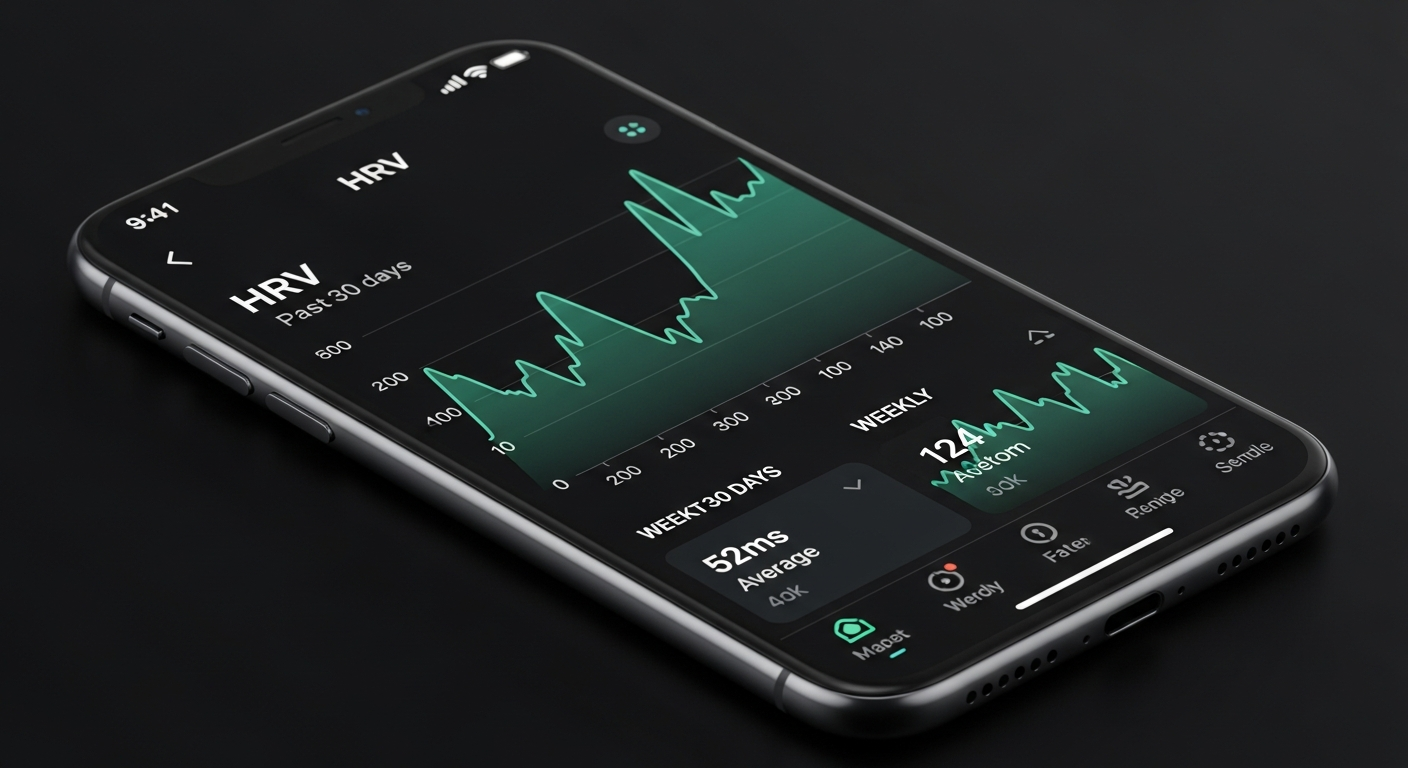
What matters is your personal trend. Your 30-day rolling average is your baseline. Day-to-day readings tell you whether you are above or below baseline. Sustained downward trends — your baseline declining over weeks — are the most significant signal. They indicate systemic under-recovery that is accumulating beneath the surface.
The goal is not to maximise absolute HRV at any single point. It is to maintain a stable or rising baseline over time — which is the signature of progressive adaptation and improving health.
What Suppresses HRV
Alcohol
Even 1–2 drinks significantly suppresses overnight HRV. Alcohol increases sympathetic activity and elevates resting heart rate, directly reducing the variability that reflects good recovery.
High Emotional or Work Stress
Cognitive and emotional stress activates the HPA axis, maintaining elevated cortisol that keeps the sympathetic nervous system active. This is why weeks of intense work — even without physical training — show up as declining HRV.
Poor Sleep Quality
Insufficient deep sleep and REM sleep reduce the parasympathetic recovery that drives HRV improvement overnight. HRV and sleep quality are mutually reinforcing — improving one improves the other.
Illness and Inflammation
The immune system activation during illness — and even sub-clinical inflammation from diet or overtraining — is reflected in suppressed HRV. This is one of HRV's most valuable uses: detecting biological stress before it becomes symptomatic.
Overtraining
Accumulating training load without adequate recovery consistently suppresses HRV. This is why using HRV to guide training intensity — going harder on high-HRV days, prioritising recovery on low-HRV days — is one of the highest-leverage applications for athletes and high performers.
Dehydration
Even mild dehydration (1–2% body weight) measurably suppresses HRV. Adequate hydration throughout the day, and particularly before sleep, supports better overnight recovery.
How to Raise Your HRV Baseline
Raising HRV baseline over time requires consistent improvement across the key levers — not a single intervention. These are the highest-impact strategies:
Consistent sleep and wake times to stabilise the circadian rhythm and autonomic nervous system
Evening decompression protocols — structured downshifting of cognitive and emotional activation before bed
Eliminating or significantly reducing alcohol, particularly within 3 hours of sleep
Cold exposure (cold showers, ice baths) to train vagal tone and parasympathetic response
Diaphragmatic breathing and HRV biofeedback — directly exercising the vagus nerve
Progressive overload in training with structured recovery periods informed by wearable data
Anti-inflammatory nutrition — reducing processed foods, refined sugar and omega-6 excess
Magnesium supplementation to support nervous system regulation and deep sleep
Using HRV Within a Coached System
HRV is most powerful when reviewed and interpreted within a structured coaching programme. Rather than reacting to individual data points, a coach uses the trend, context and combination of metrics — HRV, deep sleep, resting heart rate, Readiness Score, skin temperature — to build a complete picture of what is happening and what to adjust.
Clients in the Circadian Advantage Method who enter with an average HRV of 28ms typically leave the 12-week programme with an average closer to 48–55ms — a 60–90% improvement — driven by improvements in sleep quality, stress regulation and lifestyle behaviours.
Want to Understand and Optimise Your HRV?
We review your wearable data as part of the coaching programme and use it to drive evidence-based adjustments each week. Apply to find out how we can use your data to accelerate your results.
Apply for Coaching